Email: [email protected]
Tel: +8615796544918
Add: Room 1004, Unit 1, Building 3, Hanyu Guangnian, Shunhua Road Subdistrict, Jinan High-tech Zone, Jinan City, Shandong Province, China
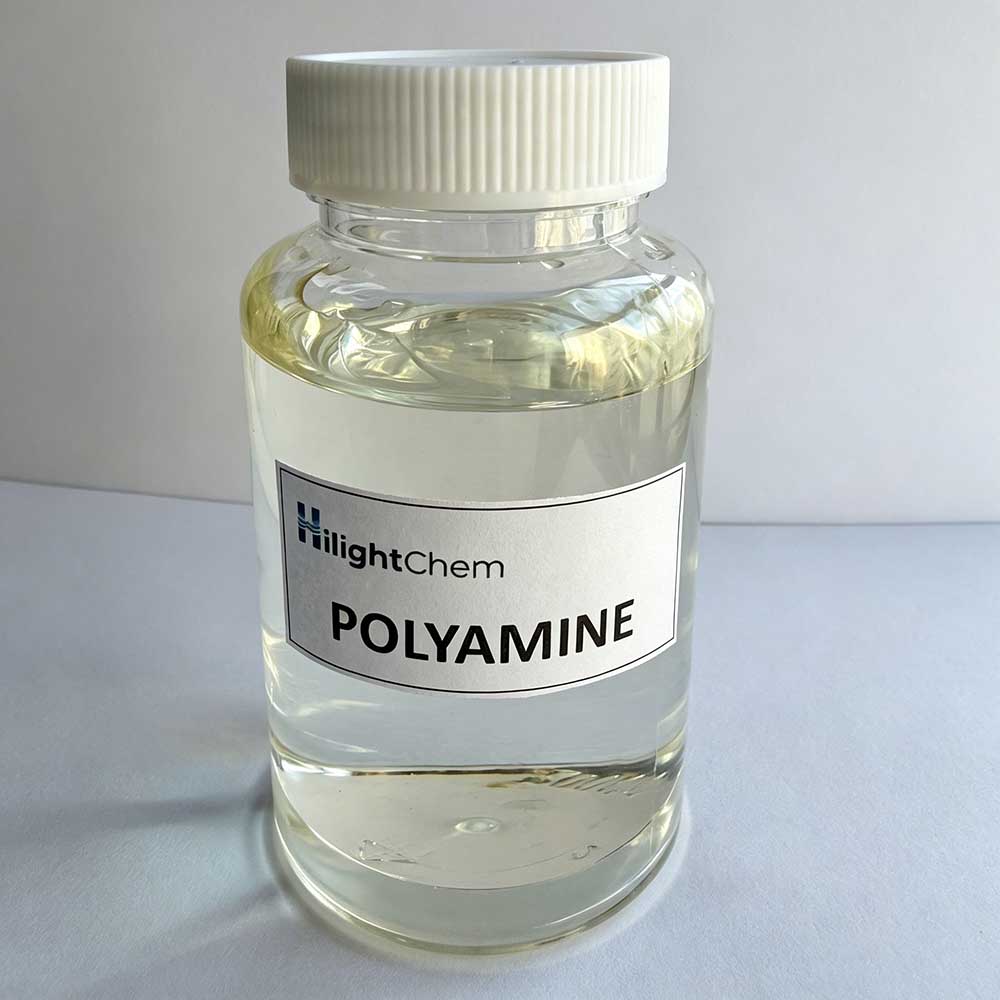
Dimethylamine-Epichlorohydrin Copolymer(Polyamine)
【Product Name】PolyAmine,Dimethylamine-Epichlorohydrin Copolymer,EPI-DA, Polyamine,Poly Epi-Amine,PAMINE
【CAS No.】42751-79-1 ,25988-97-0, 39660-17-8, 68131-73-7, 39660-17-8
Item | HL-2250 | HL-2350 | HL-2449 | HL-2550 | HL-2650 | HL-2749 |
Appearance | Colorless to light yellow viscous liquid | |||||
Content | 50% | 50% | 50% | 50% | 50% | 50% |
Viscosity,cps | 25-35 | 40-70 | 80-104 | 100-200 | 200-400 | 250-400 |
PH(1%) | 5.0-7.0 | 5.0-7.0 | 5.0-7.0 | 5.0-7.0 | 5.0-7.0 | 5.0-7.0 |
Item | HL-2850 | HL-2949 | HL-3050 | HL-3150 | HL-3249 | HL-2565 |
Appearance | Colorless to light yellow viscous liquid | |||||
Content | 50% | 50% | 50% | 50% | 50% | 65% |
Viscosity,cps | 300-500 | 650-1000 | 1000-4000 | 3500-6000 | 5000-9000 | 1000-3000 |
PH(1%) | 5.0-7.0 | 5.0-7.0 | 5.0-7.0 | 5.0-7.0 | 5.0-7.0 | 4.0-6.0 |
Dimethylamine-Epichlorohydrin Copolymer, commonly referred to as Polyamine, is a highly cationic liquid polymer. Due to its high charge density and relatively low molecular weight, it is widely used as a coagulant and functional additive across various industries.
Polyamine is primarily used as a primary coagulant or a coagulant aid. Its strong positive charge effectively neutralizes the negative charges on colloidal particles.
Flocculation: It destabilizes suspended solids, organic matter, and oils, facilitating their aggregation into larger flocs.
Decolorization: It is exceptionally effective at removing color from highly colored wastewater, particularly in industrial effluent treatment.
Sludge Dewatering: It improves the efficiency of centrifuge and filter press operations by reducing the water content in sludge.
In the textile industry, this copolymer acts as a high-performance Color Fixing Agent.
Dye Fixation: It reacts with anionic dyes (like reactive or direct dyes) to form insoluble complexes, significantly improving the wash-fastness and rubbing-fastness of fabrics.
Wastewater Treatment: It is used to treat "dye liquor" effluent, effectively precipitating residual dyes to meet environmental discharge standards.
In the paper industry, Polyamine is an essential wet-end chemical.
Pitch Control: It helps control "pitch" (natural resins from wood) and "stickies" (synthetic contaminants from recycled fiber), preventing them from depositing on paper machines.
Retention and Drainage Aid: It improves the retention of fine fibers and fillers (like $CaCO_3$) and accelerates the drainage of water during sheet formation.
Anionic Trash Collector (ATC): It neutralizes anionic trash in the pulp, which optimizes the performance of other expensive additives like sizing agents.
Polyamine is used for solid-liquid separation in mineral slurries.
Tailings Treatment: It helps in the rapid settling of tailings, allowing for better water recovery and recycling within the mine.
Filtration Aid: It increases the filtration rate of mineral concentrates (such as coal, copper, or iron ore) by creating a more porous filter cake.
In oilfield chemistry, Polyamine is used throughout the drilling and production lifecycle.
Clay/Shale Stabilization: It acts as a Shale Inhibitor in water-based drilling fluids. By neutralizing the negative charges on clay surfaces, it prevents the clay from swelling and dispersing, which maintains wellbore stability.
Produced Water Treatment: It is used as a de-oiler to separate emulsified oil from water before the water is reinjected or discharged.
Acidizing and Fracturing: It can be used to prevent fine migration, ensuring that the pores in the reservoir remain open for oil flow.
Package&Storage
125kg per PE Drum or IBC.
Store it in sealed and dark place and avoid contacting with strong oxidants. Storage period is one year.

HOT LINE
+8615796544918
Email:[email protected]
Mobile:+8615796544918
Tel:+8615796544918
Add:Room 1004, Unit 1, Building 3, Hanyu Guangnian, Shunhua Road Subdistrict, Jinan High-tech Zone, Jinan City, Shandong Province, China

Copyright © 2026 Hilight Chemial Co.,Ltd. All Rights Reserved.Technical Support:YAQIIE